

More than an iPad: Bloomsburg opens new doors to learning
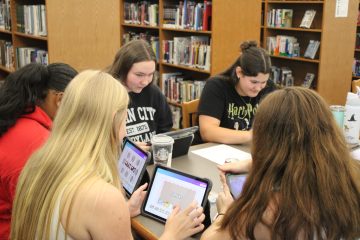
Bloomsburg High School students start Mr. Burrell’s Educational Technology class with their new iPads. All 1,500 Bloomsburg students began this school year with their own iPads and teachers prepared to help them. (Photo by BHS student Colin Littlewood)
This fall, all 1,500 Bloomsburg students in grades K-12 are beginning that journey with their own iPad. District teachers also have new MacBook laptops, supported by professional development and a technology department prepared to help them make the transition.
The district’s investment of more than $1 million in new technology represents a significant change, but Christine Matash, the district’s new director of technology and innovation, is quick to put the emphasis somewhere other than the devices themselves.
“It’s not about the devices,” Matash said. “The technology is just a tool to help students.”
Matash brought considerable experience to Bloomsburg when she assumed her position in November 2025. Her 26-year career at the Susquenita School District included work as a teacher, technology coach and, beginning in 2015, director of innovation and technology. She also holds a bachelor’s degree in elementary education and a master’s degree in instructional technology from Bloomsburg University.
Her first year in Bloomsburg has been anything but ordinary. The district’s technology transition has included not only the move from PC laptops to iPads, but also network improvements, new switches, updated parent communication and grading software, the district-wide adoption of Canvas as its learning management system, and extensive preparation for teachers.
Matash said one of the most rewarding aspects of the transition has been seeing teachers ready and willing to incorporate the new tools into their classrooms. “Teachers were prepared so they are ready to use it, and want to use it,” she said.
That preparation has been important because Matash sees technology as a way to strengthen good teaching rather than replace it. “Technology will benefit good teachers, but it won’t make bad teachers good teachers,” she said. Instead, she hopes the technology will help teachers and students emphasize the four Cs of education: critical thinking, communication, collaboration and creativity.
The early results have already provided some encouraging surprises. Students adapted quickly to the iPads, Matash said, while teachers have begun discovering possibilities for using them in ways that go beyond traditional assignments. One teacher already has students creating podcasts. An elementary teacher suggested that morning announcements could be broadcast live.
Even assessments are beginning to look different. Rather than relying on a single method to show what they have learned, students can demonstrate their knowledge in multiple ways.
For middle school teacher, librarian, and instructional technologist Phil Burrell, those possibilities are only beginning to emerge. “With the creative software tools and the camera, the iPad has opened up opportunities for students to become multimedia producers, not just consumers,” Burrell said.
He can envision middle school research students creating mini-documentaries or podcasts to demonstrate what they have learned through passion-project research. His high school students in a college-level Educational Technology course have already used the iPad for graphic design and video production to create thank-you messages for former teachers.
In one of Burrell’s middle school research classes, students used their iPads to complete physical and virtual library scavenger hunts, taking screenshots and photographs along the way. “We have only scratched the surface,” Burrell said. “We are only limited by our imagination.”
But the transition has not been simply about learning new software or discovering new classroom activities. It has also required teachers to become learners themselves. Burrell said the technology overhaul forced him to reconsider one of the traditional expectations of teaching: that the teacher should always have the answers. “I needed to remind myself that it is OK to be vulnerable with my students,” he said.
Trying new practices without knowing exactly how they will work — and sometimes making mistakes in front of students — can be challenging. Yet Burrell believes that vulnerability can create a healthier classroom environment by showing students that learning includes experimentation, challenge and failure. “Modeling the learning process, including its failures, is incredibly important to help students build positive lifelong habits,” he said. For students, meanwhile, the learning curve has been balanced by a familiarity with technology that is already part of their everyday lives.
Bloomsburg High School student Brenyn Wasielewski said the iPad feels considerably more interactive than the district’s former ThinkPads. The ability to use a digital pen to handwrite notes directly on slides, draw diagrams, and annotate materials has changed how Brenyn approaches schoolwork. Notability has become a central hub for taking notes, while the iPad’s portability has reduced the number of notebooks and folders needed for classes.
There are still adjustments. Brenyn said multitasking and quickly navigating between multiple open apps remain skills to develop.
But the transition has already solved one particularly familiar problem: waiting.
Switching between classes is faster because the iPad doesn’t take as long to wake from sleep mode as the previous laptops.
For Matash, however, the ultimate goal extends well beyond faster devices or easier transitions between classes. She wants students throughout the district to have consistent access to technology and teachers to have the tools and support they need to use it effectively. “My goal is to provide consistency throughout the district,” she said.
That consistency also creates opportunities for students at different grade levels. Matash points to accessibility features such as text-to-speech that allow even young learners to benefit from the technology, while giving all students opportunities to experience a sense of accomplishment with new tools.
Burrell sees the broader goal as student ownership. “It will help me to empower my students to take stronger ownership of their learning,” he said. “With these new tools, my hope is to make my students’ classroom experiences even more student-centered.” That may ultimately be the most important measure of the district’s investment. The iPads are new. The software is new. Teachers and students are still discovering what is possible. But the technology itself is not the destination.
A year from now, Matash said, success will be reflected in consistency, improved communication and greater opportunities for teachers and students to use technology as a learning tool. And she hopes the change will bring something that cannot be measured by the specifications of a device. “A new excitement about learning will improve academic growth,” Matash said. For 1,500 Bloomsburg students, that may be the most meaningful opportunity their new technology provides.